Base’s 2026 AI Admin Debt Study reveals how much time leaders spend managing the tools designed to make their work easier, and why human support remains essential to realizing AI’s potential.
When artificial intelligence began transforming the workplace in 2023, the promise was compelling. New tools would take over repetitive tasks, simplify everyday operations, and give business leaders more time to focus on strategy, relationships, and the decisions that matter most. Three years later, AI has become part of how many of us work, helping us research information, develop ideas, analyze data, create content, and accomplish tasks that previously required considerably more time and resources.
Yet the experience of using AI has proven more complicated than many anticipated. While these tools can produce impressive results in seconds, getting those results ready for practical use often requires substantial effort. Someone must develop the right prompts, verify the information, correct mistakes, refine the output, and make sure the finished product meets expectations. Workflows must be created, tested, maintained, and adjusted as the technology evolves, while new tools and capabilities demand additional time to evaluate and learn.
These responsibilities have gradually become part of the working day, often without any formal recognition of the time they consume. At Base, we have a name for this growing operational burden: AI Admin Debt.
Understanding the work behind AI productivity
AI Admin Debt describes the time and effort involved in managing AI tools and turning their outputs into completed work. It includes the administrative responsibilities that emerge as organizations incorporate AI into everyday operations, from researching and configuring tools to reviewing generated content, maintaining automations, and coordinating the many steps required to complete a project.
Consider an executive who uses AI to prepare a presentation, develop a marketing campaign, or organize a business initiative. The initial output may appear within minutes, but the executive may still spend hours refining the content, checking the accuracy of the information, adjusting the format, and bringing together materials produced across several platforms. Even after the work is complete, the systems and processes behind it may require continued attention.
As AI makes it easier to generate ideas and initiate projects, leaders may find themselves responsible for an increasing number of unfinished tasks. They become their own researchers, writers, designers, and technology administrators, moving between applications and managing the details that connect one stage of work to another.
This growing responsibility raises a question at the heart of Base’s AI Admin Debt Manifesto: We might feel more productive, but are we actually producing more? Or are we just busier?
To explore that question, Base conducted the AI Admin Debt Study, 2026, surveying 74 operators between April 28 and June 15, 2026. Participants included founders, CEOs, operations leaders, and senior team members across several industries, with approximately 70% working at companies with 50 or fewer employees. Their responses offer a closer look at the relationship between AI adoption, perceived productivity, and the operational work required to use these technologies effectively.
What the research reveals about AI Admin Debt
Productivity gains come with considerable rework
Among the 74 operators surveyed, 77% reported that AI makes their time feel more productive, reflecting the value these technologies bring to everyday work. At the same time, 68% said they need to adjust AI-generated output most of the time or almost always before they can use it, suggesting that the speed of producing an initial result tells only part of the productivity story.
For many respondents, the process of working with AI involves reviewing information, correcting inaccuracies, rewriting content, and applying the professional judgment that automated systems cannot consistently provide. One founder in professional services described AI as an invaluable thought and research partner while emphasizing that verification remains unavoidable.
These experiences illustrate how the administrative responsibilities surrounding AI can absorb a meaningful portion of the time that technology initially appears to save. An executive may produce a draft more quickly than before, but the hours spent reviewing and completing that draft still belong in any meaningful assessment of productivity.
A small number of tools can create a substantial workload
Discussions about AI adoption frequently focus on the growing number of platforms available to businesses, yet Base’s research suggests that the administrative burden can be significant even when people use relatively few tools.
The study found that 91% of respondents use six or fewer AI tools during a typical workweek, while 34% spend eight or more hours each week on the work associated with using AI. For these operators, the time devoted to configuring tools, developing prompts, checking outputs, and maintaining workflows can amount to at least one full working day.
The findings suggest that much of the burden comes from the ongoing effort required to use existing tools effectively. Even a carefully selected collection of applications requires attention as business needs change, workflows evolve, and new capabilities become available.
For leaders who are already balancing operational responsibilities with business development, team management, and strategic decisions, these additional hours represent a considerable commitment.
AI management has become another responsibility for business leaders
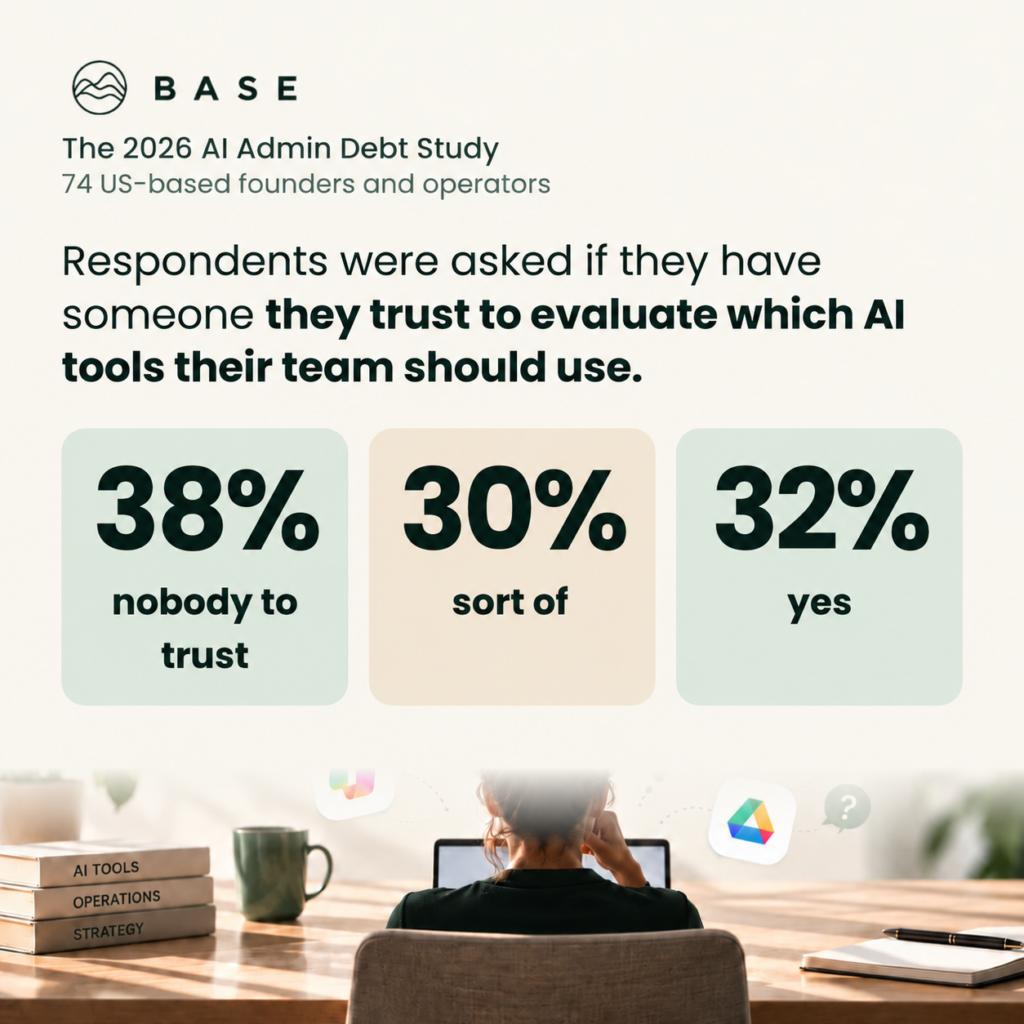
One of the study’s most significant findings concerns who takes responsibility for managing AI within an organization. Among respondents, 80% said they personally manage their AI workflows day to day, while another 12% reported that the responsibility is distributed across their teams without a single designated owner.
The research also found that 68% of respondents lack someone they fully trust to evaluate which AI tools their team should use. Within that group, 38% said they have no such person, while another 30% indicated that they have someone they trust only to some extent.
Together, these findings suggest that many executives and operators have absorbed a new set of responsibilities alongside their existing work. They are expected to evaluate technology, determine how it should be used, establish processes, monitor performance, and resolve problems as they arise, often while continuing to manage the business activities that originally justified adopting AI.
As these responsibilities accumulate, the question of ownership becomes increasingly important. Organizations need people who understand how the tools function, how different workflows connect, and how to translate AI-generated outputs into work that is accurate, useful, and ready to implement.
Human executive support may help reduce the burden
The study also examined differences in AI-related workloads among respondents with and without executive support. Among those with full-time support from an executive assistant, chief of staff, or similar professional, 20% reported spending eight or more hours per week on AI-related work, compared with 36% of respondents who had no executive support.
This comparison provides an interesting perspective on the potential value of human assistance in an increasingly technology-driven workplace, although the results require careful interpretation. The full-time support group included only 10 respondents, and the study does not establish that having executive support caused the difference in time spent managing AI.
Nevertheless, the findings raise a useful question about how organizations distribute the responsibilities associated with AI adoption. When leaders have access to capable professionals who can help coordinate workflows, manage tools, review outputs, and follow through on operational details, there may be opportunities to reduce the amount of time executives spend handling those responsibilities themselves.
The evolving role of the executive assistant
For decades, executive assistants have helped business leaders manage the systems, information, and processes that support their work. Their responsibilities have evolved alongside workplace technology, from maintaining calendars and correspondence to coordinating complex projects, managing digital platforms, improving workflows, and ensuring that important tasks move toward completion.
The growing use of AI introduces another dimension to this work. An AI-literate executive assistant can help evaluate tools, develop and maintain workflows, prepare and refine AI-generated materials, coordinate information across platforms, and ensure that outputs are translated into practical results. These responsibilities build on the organizational knowledge, attention to detail, and understanding of executive priorities that have long made effective assistants valuable partners.
At Base, we see this evolution as a natural extension of executive support. For fourteen years, we have worked to connect business leaders with executive assistants who understand their needs and can help manage the operational demands of their work. As AI becomes more deeply integrated into business operations, this same philosophy guides how we recruit, train, and support our executive assistants, preparing them to work confidently with emerging technologies while maintaining the human judgment and organizational expertise that effective executive support requires. This commitment is reflected in our [AI Admin Debt Manifesto], where we explore the growing responsibilities created by AI and the importance of having skilled human support to manage them.
An executive who delegates the ongoing administration of AI workflows can devote more attention to the decisions, relationships, and opportunities that require their expertise. Meanwhile, a skilled assistant can help ensure that the tools remain useful, the work stays organized, and projects continue progressing beyond the initial AI-generated draft.
A more sustainable approach to AI productivity
The findings from Base’s 2026 study offer an opportunity to reconsider how organizations measure the value of AI. Faster research, quicker drafts, and more efficient information processing are meaningful improvements, but their full value depends on what happens after those initial outputs are generated.
Businesses also need to account for the time spent learning new systems, managing workflows, checking results, and bringing projects to completion. These activities are essential to making AI useful, and they deserve the same consideration as other operational responsibilities when organizations decide how to allocate time, resources, and support.
As AI capabilities continue to expand, the administrative work surrounding them will remain an important part of the conversation about workplace productivity. Establishing clear ownership, developing reliable processes, and providing appropriate human support can help organizations make more effective use of the technology they have already adopted.
The vision of a lighter, more productive working day that accompanied the early excitement around AI remains worth pursuing. Achieving it will require thoughtful decisions about how work is organized, who is responsible for managing the tools, and how leaders can spend more of their time on the responsibilities that matter most.
At Base, we believe AI-literate executive assistants have an important role in helping make that vision possible.
Explore the 2026 AI Admin Debt Study
Base’s AI Admin Debt Study, 2026 examines the experiences of 74 operators, including their perceptions of productivity, the time they spend managing AI tools, the responsibilities they carry, and the relationship between AI-related workloads and executive support.
About the research: Base surveyed 74 operators between April 28 and June 15, 2026. Participants were recruited through LinkedIn, professional Slack communities, and the Base network. The sample was self-selected and unweighted, with a concentration of founders and operators from smaller businesses who already use AI regularly. The findings describe the experiences of these respondents and are not intended to represent all executives or businesses.